Book a free demo with one of our many compliance experts when it works for you.
Last updated November 2026.
The short answer
- What it is: a report from an independent CPA firm about the controls covering the system under review. A Type 1 report evaluates how those controls are designed as of a specific date. A Type 2 report also evaluates whether they worked as intended over a period of time. It is not a certification.
- When you need it: when a customer's security review asks for it. Ask them which report they accept, and by when, before you spend anything.
- What to cover: start with Security. Ask the buyer whether they also require Availability, Confidentiality, Processing Integrity or Privacy.
- Type 1 or Type 2: most startups only need the Type 2. A Type 1 (about $4,000) is usually a bridge when a deal cannot wait.
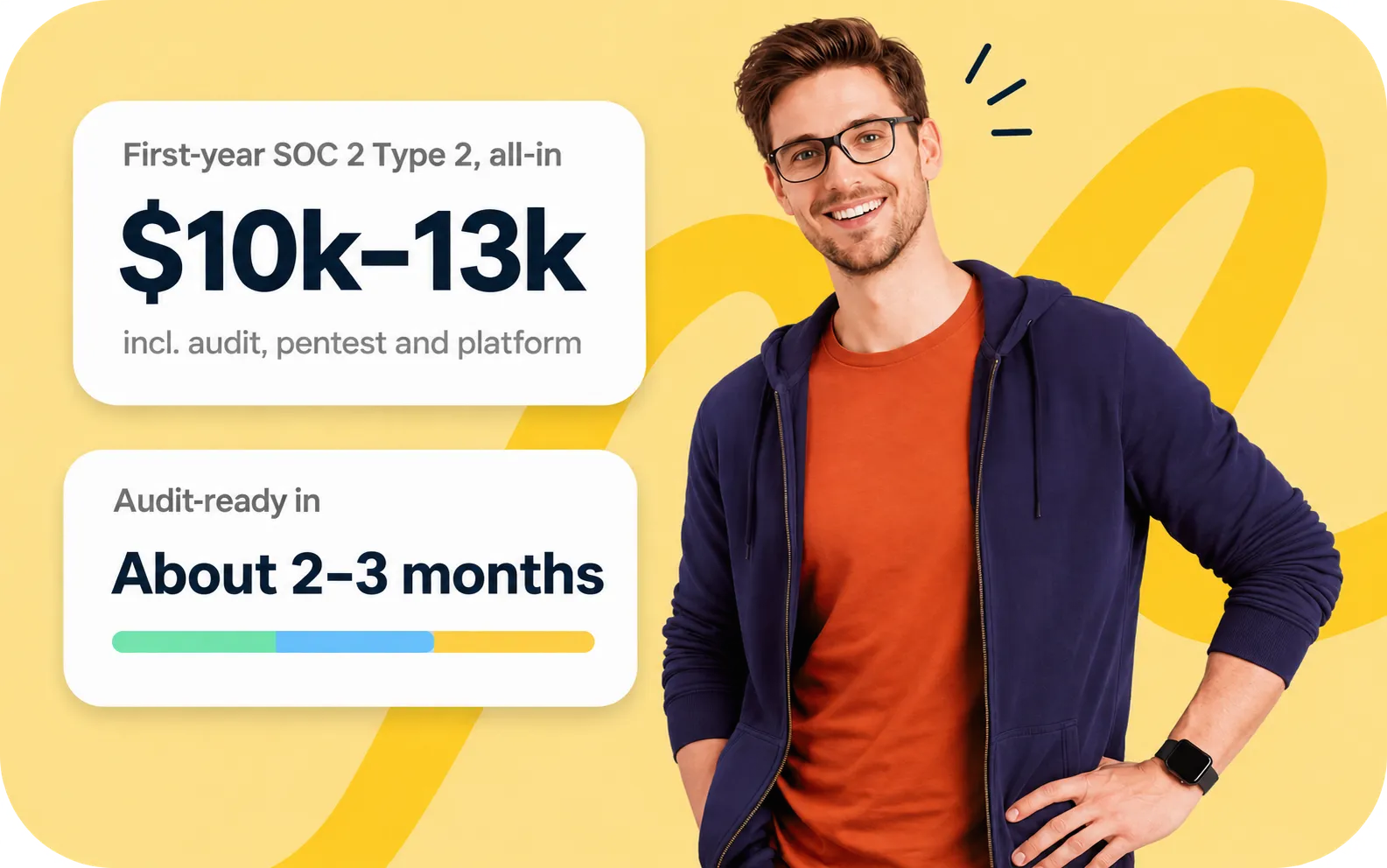
- How much SOC 2 costs a startup: for a five-person startup, an example first-year budget for SOC 2 Type 2 is $10,000 to $13,000 in real money. That includes about $1,800 for a compliance platform, $6,000 to $8,000 for the audit, and $2,500 to $3,500 for a penetration test if included. A Type 1 audit is estimated at $4,000.
- How long SOC 2 takes: plan on 2 to 3 months to get audit-ready, with about 30 to 50 hours of founder time. For Type 2, budget another 3 to 6 months for the observation period. The CPA firm issues the report after that period ends and it completes its work.
What SOC 2 is, and what it is not
SOC 2 is a framework from the AICPA, the American accounting body, for showing that a company that handles customer data protects it properly. You do not pass SOC 2 the way you pass an exam. An independent CPA firm examines your controls and writes a report with its opinion. That report is what your customer asks for.
People say "SOC 2 certification" all the time, and you will hear it from buyers too. Strictly speaking, there is no certificate. There is an attestation report, issued by the CPA firm, not by your compliance platform. A platform cannot attest its own customers, which is exactly why buyers trust the independent sign-off.
When you send the report to a buyer, point them to the auditor's opinion, the scope and any exceptions the auditor found.
When does a startup need SOC 2?
SOC 2 is not a legal requirement. It becomes a business requirement when someone you want to sell to asks for it. Common triggers:
- a prospect's security questionnaire asks whether you have a SOC 2 report,
- a procurement process asks for a report before the deal can move,
- the buyer's lawyers add security requirements to the contract.
If none of that is happening yet, consider whether SOC 2 is the right priority for your stage, especially before you have revenue or if your customers never run a vendor review. The basics are still worth putting in place early (multi-factor login on everything, a list of who can reach customer data): they are part of the foundation SOC 2 builds on.
The single most useful move when a buyer mentions SOC 2 is to get them to tell you, in writing, which report they will accept (Type 1 or Type 2), what it needs to cover and by when. Then decide on scope. Not before.
SOC 2 Type 1 vs Type 2: which does a startup need?
Most startups only need the SOC 2 Type 2, the report buyers usually want in the end. A Type 1 is a cheaper bridge when a deal cannot wait. The difference:
- Type 1 checks that your controls are designed properly and in place on one date. It costs less, and there is no observation window.
- Type 2 checks that your controls actually worked over a period, the observation window, usually 3 to 6 months. It is usually the report buyers ultimately want.
How to choose:
| What the buyer says | What to do |
|---|---|
| A Type 1 is fine for now | Get the Type 1 (about $4,000) now, and start the Type 2 observation window after it |
| We need a Type 2 | Go straight to the Type 2 ($6,000 to $8,000) and agree the 3 to 6 month observation window with your auditor |
| Not sure yet | Ask in writing which report, what scope and by when, before you spend anything |
Some customers take the Type 1 as a bridge: something to show a blocked deal now, while the Type 2 observation window runs.
Plans also change mid-way. One of our customers started a Type 2 observation window, stopped it after ten days and switched to a Type 1 first (more on that below). That is a normal, sensible correction, not a failure.
Scope: start with Security
SOC 2 uses the AICPA's Trust Services Criteria, grouped into five categories. Security is required for all SOC 2 examinations, while the other four categories are included based on the organization's services and commitments.
| Category | What it covers |
|---|---|
| Security | Protecting systems and information against unauthorized access. Every SOC 2 report includes it |
| Availability | Whether your system is up and usable as promised |
| Processing integrity | Ensuring systems process information completely, accurately and on time |
| Confidentiality | Protecting information designated as confidential |
| Privacy | How personal information is collected, used, retained and disposed of |
In our experience, Security alone satisfies many buyers. If a buyer asks for another category, confirm the scope with the buyer and your auditor before expanding the program.
To be clear about our own scope: Klaay supports the Security category.
How much does SOC 2 cost for a startup?
In our experience, this is the first question founders ask. The useful answer is not a single big number but what that number includes.
A 5-person startup pays $10,000 to $13,000 in real money for a first-year SOC 2 Type 2, including the penetration test. The breakdown:
| What | Cost | Paid to |
|---|---|---|
| Compliance platform | about $1,800 a year | Klaay (Starter, billed annually) |
| Type 2 audit | $6,000 to $8,000 | an independent CPA firm |
| Penetration test | $2,500 to $3,500 | a penetration testing firm |
| Type 2 total, including penetration test | $10,000 to $13,000 | |
| Your own time | roughly 30 to 50 hours of founder time |
Most startups only need the Type 2. If a buyer will accept a Type 1 for now, that audit is about $4,000, and the Type 2 usually follows later. The audit and the penetration test are separate third-party costs, not fees paid to Klaay.
What pushes the price up:
- more categories in scope,
- more systems in scope, especially systems that affect customer data, access or security controls,
- a large audit firm where a smaller specialist would do,
- starting late, when a deal is already waiting and everything becomes urgent.
Year two: SOC 2 is not one and done. In year two the platform renews (about $1,800 a year at five people), and when your buyers need a newer report you pay for another audit: $6,000 to $8,000 for a Type 2 through partner audit firms, plus a penetration test if your buyer or auditor asks. Ask your buyers how recent the report must be.
You do not need a demo, a sales call or a quote to find out what Klaay costs. Every price is on our pricing page. You can also try it before you pay: Klaay has a 14-day free trial, no credit card required. Even if you end up choosing a different platform, it shows you what the work looks like in practice.
How long does SOC 2 take for a startup?
From a standing start, most teams get audit-ready in about 2 to 3 months, with roughly 30 to 50 hours of founder time spread across that period. Audit-ready is not the finish line:
- a Type 1 is then a point-in-time audit,
- a Type 2 needs an observation window, typically 3 months and up to about 6.
Realistic total to a first Type 2 report: about 6 to 7 months. That is 2 to 3 months to get audit-ready, an observation window of about 3 months, then about 1 month for the audit and the report.
The phases:
- Scope and gap analysis. What is in scope, and what is missing.
- Policies and controls. Write the policies, put the controls in place.
- Evidence. Connect your systems so evidence is collected as you go.
- Penetration test. Usually before the audit or the observation window.
- Auditor. Engage the CPA firm and agree the scope and date.
- Audit. For Type 1, agree on the date your controls will be assessed. For Type 2, the CPA firm tests how your controls operated over the agreed period and issues the report after completing its work.
Two real timelines from our customers, anonymized:
Customer A, a small SaaS team, Security-only scope. Signed up in late July. Engaged their audit firm about two months in and agreed a Security-only scope for year one. Planned to start the Type 2 observation window at about three months, then moved it back about two weeks because too many checks were still failing. The lesson: start the observation window once your controls are in place and your team is ready to show how they work.
Customer B, a small team with very little founder time. Signed up in early August and started a Type 2 observation window at about three months. Ten days in, they stopped it: the founder was down to about two hours a week. They re-planned to a Type 1 at about six months, with the Type 2 window to follow. The lesson: your timeline is set by the hours someone actually has, not by the tool.
Who does the work
- The platform gives you the templates, the control framework and the workflow. With Klaay that means policies, the control set, evidence collection from your systems and AI guidance along the way, which automates 90% of the compliance work.
- Your team puts the controls in place and answers the auditor's questions. Nobody can do that part for you.
- The CPA firm tests the controls and issues the report.
In short: you get the templates, framework and workflow, your team puts the controls in place, and we make it structured and fast.
Three ways to prepare:
- Spreadsheet and shared drive: your team does all of it and collects the evidence by hand. You pay for the audit and the penetration test.
- Compliance platform: the platform supplies the templates, controls and evidence collection, and your team puts the controls in place. You pay for the platform on top.
- Consultant: advises and coordinates, while your team still puts the controls in place and answers the auditor. You pay consulting fees on top.
Whichever path you take, only the CPA firm can issue the report.
How to judge a compliance platform:
- Is the price published?
- Does it cover the scope your buyer asked for? Ask about anything beyond Security.
- Does it connect to the tools you already use?
- Will it tell you which audit firm signs your report?
- Can you try it before you pay?
- What does year two cost?
For a side-by-side of the main platforms, see our guide to the best SOC 2 tools for startups.
Two practical points:
- Name one owner. One person, usually the CTO or a technical founder, with hours blocked in their calendar. Customer B above shows what happens without that time.
- You do not strictly need a platform. No auditor requires a compliance platform, but they do ask how you manage controls and evidence. A spreadsheet and a shared drive can work. A platform makes that answer shorter and gives your team a structured place to manage the evidence.
What auditors actually look at
"Auditors look at whether your controls address your risks and whether your team follows them. Write policies that describe what you actually do, and keep evidence that shows you did it."
"Before you start the observation window, make sure your controls are in place and you know how you'll show they're working. Automated checks can help, but some controls need evidence from your team."
"Pick one person who owns SOC 2 and give them real hours. Most delays I have seen were not technical. Nobody had time."
"In an audit, if it's not documented, it's as if it never happened. Keep a simple, consistent record each time you perform a control so you can show what was done, when, and by whom."
Louis Van Der Westhuizen, Principal at Impact Risk Advisors, CISA, CIA, CISSP
How to get SOC 2 as a startup, step by step
- Confirm what the buyer needs. Report type, scope, deadline, in writing.
- Set the scope. Security, and the systems that touch customer data.
- Run a gap analysis. Compare what you do today with the controls you need.
- Write policies and put controls in place. Policies should describe what you really do.
- Collect evidence. Connect your systems so it happens continuously, not in a panic before the audit.
- Get a penetration test and fix what it finds.
- Pick an auditor and set the date.
- Get the report, then keep it running. The evidence for your next audit starts the day after this one.
For the long version of each step, see our step-by-step guide to getting SOC 2 as a startup.
Penetration testing
If your buyer or auditor asks for a penetration test, plan for one. Through a partner testing firm, a standard small company pays $2,500 to $3,500; very small teams usually land at the bottom of that range.
Questions worth asking any penetration testing firm:
- Is a person doing the testing, or only a scanner?
- Is a retest included once you have fixed the findings?
- Will you get a summary you can share with your auditor and customers, not just a raw export?
Choosing an auditor, and who signs your report
Things to check before you pick an audit firm:
- It is a CPA firm. Ask for its latest AICPA peer review result.
- It works with startups. Ask how many companies your size it has audited.
- You know who signs before you buy. If an audit comes bundled with anything, ask which firm will sign your report and check it the same way.
- Your buyers will accept it. If a deal depends on it, ask the buyer whether the firm you are considering is acceptable.
Klaay does not issue SOC 2 reports and cannot: an independent CPA firm does. We work with partner audit firms so you do not have to find one on your own.
What to send a buyer before you have the report
The buyer's security review keeps running while you prepare. What keeps it moving is material the reviewer can check:
- A security overview: what the product does, where customer data lives, how it is encrypted, who can access it.
- Your policies, or at least the main ones.
- Your list of subprocessors: the third parties that touch customer data.
- A recent penetration test summary.
- A dated plan: the report type, the audit firm if you have engaged one, and the expected date.
A dated plan gives the buyer something specific to evaluate. "Soon" does not.
Will the proposed 2027 SOC 2 criteria change your first audit?
Probably not. In October 2026 the AICPA proposed an updated set of SOC 2 Trust Services Criteria. Comments close on January 15, 2027. If the update is adopted, it applies to audits that start on or after December 31, 2027, and early adoption is allowed. So a first SOC 2 that starts in 2027 is still audited against today's criteria, unless you choose to adopt the new ones early.
Source: AICPA, "AICPA Proposes Update of SOC 2 Trust Services Criteria", October 2026.
What the proposal changes: the Common Criteria are reorganized from 33 into 20 criteria. Oversight by a board becomes oversight by "those charged with governance", which fits small companies run by their founders. Change management splits into three criteria (infrastructure, acquired software and the software you build), which makes the expectations for your development pipeline clearer. Vendor management explicitly covers APIs, plugins and AI models. AI does not get its own category: AI points of focus are added to the existing criteria. For a typical small SaaS company this is a modernization more than a bigger workload, and it may even simplify things. If your product relies heavily on AI, expect more questions about how you manage, test and monitor it. Either way, you do not need to change your controls because of the proposal.
This section describes the proposal as of November 2026. We will update it when the AICPA publishes the final version.
Frequently asked questions
How much does SOC 2 cost for a small startup?
A 5-person startup can budget $10,000 to $13,000 in real money for a first-year SOC 2 Type 2: about $1,800 for a compliance platform, $6,000 to $8,000 for the audit and $2,500 to $3,500 for a penetration test.
How long does SOC 2 take for a startup?
Most startups get audit-ready in about 2 to 3 months, with roughly 30 to 50 hours of founder time. A Type 2 then needs an observation window, realistically about 3 months, and the audit takes about a month after that. In total, plan on about 6 to 7 months to a first Type 2 report.
What is the cheapest way to get SOC 2?
Keep the scope to Security and to the systems that touch customer data, use a smaller specialist audit firm your buyer accepts, start before a deal is waiting, and ask whether your buyer will accept a Type 1 (about $4,000) for now.
What is the fastest realistic path to SOC 2?
A Type 1. Plan on about 2 to 3 months to get audit-ready, then a point-in-time audit. The pace is set by the hours your owner has.
Is SOC 2 required by law?
No. For most startups, SOC 2 comes up because a customer asks for it during a security review or makes it a contract requirement.
Is SOC 2 a certification?
No. It is an attestation report from an independent CPA firm. See what "SOC 2 certification" really means.
Can a very small startup get SOC 2?
Yes. We work with startups and SMBs with 2 to 150 people, including seed to Series A SaaS startups, and the costs above are for a 5-person team.
Do we need a compliance platform?
No auditor requires one, but they do ask how you manage controls and evidence. A platform is a labor decision: it saves your team time and makes the audit smoother.
How long is a SOC 2 report good for?
A SOC 2 report has no formal expiry date, but most buyers want one whose period ended within the last 12 months. Renewal periods usually run back to back, and a bridge letter from your company covers short gaps between reports.
Can we skip the Type 1?
Yes, if your buyer is happy to wait for the Type 2. Many teams use a Type 1 only as a bridge for a deal that cannot wait.
Does SOC 2 cover HIPAA?
No. SOC 2 and HIPAA have separate requirements. Some of the same security controls and evidence can support both. Klaay supports SOC 2 and HIPAA today, so both can run from the same account. See HIPAA compliance.
Get started
Klaay is free to try, with no credit card required, and plans start from $149 a month billed annually. No demo required, though we are happy to show you around if you want one. See pricing or start now.