Book a free demo with one of our many compliance experts when it works for you.
Compliance Automation: The Complete Guide for Modern SaaS & AI Companies
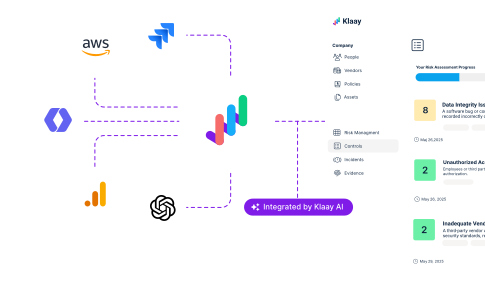
Compliance automation is software that replaces the manual work of a security compliance program: collecting evidence from your cloud and tools, keeping policies current, monitoring controls, and preparing for the audit.
For a SaaS startup pursuing SOC 2, a platform such as Klaay automates about 90% of that work, from $149 a month, so a small team can get audit-ready in about 2 to 3 months without a consultant.
How much of the audit can actually be automated? In Klaay that 90% breaks down as policies generated from how your company operates, evidence collected continuously from more than 100 integrations, controls monitored with alerts when something fails, and an audit hub where the evidence is organized for the auditor. Your team still puts the controls in place, and an independent CPA firm still issues the report. AI onboarding cuts setup time by about 95%.
If you're evaluating compliance platforms like Vanta or Drata, you’re likely trying to:
- Achieve or maintain SOC 2 compliance
- Reduce manual audit preparation
- Centralize security documentation
- Accelerate enterprise sales
- Replace spreadsheets and consultant-heavy workflows
- Improve risk visibility
But compliance automation has evolved.
The real question isn’t:
“Can this tool help us get SOC 2?”
The real question is:
“Will this compliance automation software scale with our security maturity or will we outgrow it?”
This guide explains what modern compliance automation should look like and how to evaluate compliance management platforms strategically.
What Is Compliance Automation?
Compliance automation is the use of software to continuously monitor, document, and validate security controls across your organization.
Modern compliance automation software helps teams:
- Automatically collect audit evidence
- Monitor cloud configurations in real time
- Track risk posture across systems
- Centralize policies and documentation
- Manage vendor risk
- Prepare for frameworks like SOC 2, ISO 27001, HIPAA, and emerging AI governance standards
Instead of:
- Taking screenshots before audits
- Updating spreadsheets manually
- Chasing engineers for documentation
- Preparing once per year
Compliance automation creates an always-on compliance system.
This is the process we refer to as continuous compliance.
But not all compliance automation platforms deliver this equally.
If You’re Evaluating Compliance Automation Platforms Right Now…
You’re probably in one of these situations:
- An enterprise deal is blocked on SOC 2
- Your team is preparing for a SOC 2 audit
- Your current compliance management software feels task-heavy
- Engineering is frustrated with compliance overhead
- Vendor risk lives in spreadsheets
- AI governance expectations are increasing
- You’re comparing GRC software options
If that sounds familiar, you’re not just looking for a compliance dashboard.
You’re looking for leverage and that changes everything.
SOC 2 Automation: Where Most Teams Start
For SaaS companies, compliance automation usually begins with SOC 2.
SOC 2 automation software should:
- Map Trust Services Criteria to real controls
- Integrate directly with AWS, Azure, GCP
- Connect to identity systems like Okta or Google Workspace
- Automatically collect evidence
- Detect configuration drift
- Surface control gaps before audits
- Streamline auditor collaboration
That’s table stakes for modern SOC 2 compliance software.
In Klaay, controls map to the Trust Services Criteria, evidence is collected automatically, drift is detected, gaps are surfaced before the audit, and the auditor works from an audit hub instead of a folder of screenshots. Klaay integrates directly with AWS, Google Cloud Platform and Azure, and with Google Workspace, Microsoft Entra ID and Okta.
But SOC 2 is just the beginning.
If your compliance automation platform only optimizes for passing a SOC 2 audit, you may quickly hit limitations.
The Problem with First-Generation Compliance Platforms
Early compliance automation tools solved an important problem:
They helped startups pass audits faster.
But many still operate primarily as:
- Task management systems
- Checklist-based frameworks
- Policy template libraries
- Evidence storage platforms
They optimize for:
“Getting audit-ready.”
Not:
“Building a continuously secure organization.”
That distinction becomes clear after the first audit cycle.
Audit-Ready vs. Continuously Secure
There is a fundamental difference between:
Audit-ready once per year
and
Continuously secure every day
Audit-ready tools focus on documentation cycles.
Continuously secure systems focus on:
- Real-time control monitoring
- Proactive risk detection
- Ongoing maturity tracking
- Intelligent gap remediation
- Vendor risk intelligence
Ask yourself:
Is your compliance platform preparing you for an event or improving your security posture daily?
That answer determines whether compliance becomes strategic infrastructure or recurring overhead.
What Modern Compliance Automation Software Should Deliver
If you’re investing in compliance automation today, it should provide more than checklists.
It should function as risk and compliance software — not just audit preparation software.
Here’s what that looks like.
1. Continuous Control Monitoring
Controls should be verified in real time.
If a configuration drifts, the system should detect it immediately.
Examples:
- Public S3 bucket exposure
- Disabled MFA
- Privileged access misconfigurations
- Missing encryption settings
Compliance automation software should surface control drift automatically.
2. Automated Evidence Collection
Your platform should integrate directly with:
- AWS, GCP, Azure
- Okta, Google Workspace
- GitHub
- HR systems
- Endpoint management tools
- Ticketing systems
Manual screenshots should be the exception — not the workflow.
Klaay integrates with AWS, Google Cloud Platform and Azure, with Google Workspace, Microsoft Entra ID and Okta, and with GitHub and Jira. Custom integrations are available on request.
Automated evidence collection reduces audit preparation time significantly.
3. Risk-Centered Visibility
Compliance is not just about passing controls.
It’s about understanding risk.
Modern compliance management software should:
- Map controls to actual risks
- Prioritize gaps based on impact
- Provide executive-level reporting
- Track security maturity over time
Without risk context, compliance becomes surface-level documentation.
4. Framework Scalability
Your compliance automation platform should allow expansion from:
- SOC 2
to - ISO 27001
- Vendor Risk Management
- AI governance frameworks
- Custom internal controls
Without rebuilding your compliance system from scratch.
Framework scalability is what separates basic audit tools from real GRC platforms.
5. Minimal Engineering Friction
Compliance should not feel like a recurring tax on your engineering team.
The right compliance automation software:
- Reduces interruptions
- Minimizes manual requests
- Integrates into existing workflows
- Improves visibility without increasing overhead
Engineering friction is often the hidden cost of poorly implemented compliance systems.
Compliance Automation for AI-Native Companies
AI introduces new compliance complexity:
- Model governance
- Data lineage documentation
- Third-party AI vendor risk
- Responsible AI controls
- Emerging regulatory scrutiny
Many compliance automation tools were built before AI governance became central.
If you’re building or integrating AI systems, your compliance architecture must support:
- AI vendor due diligence
- Risk-based AI controls
- Documentation of AI usage
- Continuous governance oversight
Compliance automation must evolve alongside intelligent systems.
Otherwise, you’ll manage AI risk outside your compliance platform — creating fragmentation.
Compliance Automation vs. Traditional GRC Software
Some organizations evaluate traditional GRC software (Governance, Risk, and Compliance platforms).
Enterprise GRC platforms often provide:
- Deep configurability
- Extensive risk registers
- Complex workflow engines
But they can also introduce:
- Heavy implementation timelines
- Administrative overhead
- Configuration complexity
- Enterprise-scale pricing
For modern SaaS startups, lightweight but intelligent compliance automation software often provides stronger operational leverage.
The goal isn’t to replicate enterprise bureaucracy.
It’s to build scalable security infrastructure.
When Does It Make Sense to Switch Compliance Platforms?
You might consider switching if:
- Your current tool feels task-heavy
- You still collect manual evidence frequently
- Vendor risk management lives outside your platform
- AI governance workflows are unsupported
- Engineering teams complain about compliance friction
- Executive reporting lacks depth
- You’ve outgrown basic SOC 2 automation
Switching compliance management software is a serious decision.
But staying with a platform that plateaus your security maturity can slow growth.
Switching Compliance Platforms Shouldn’t Be Disruptive
Compliance touches:
- Security
- Engineering
- Leadership
- Audit workflows
- Sales operations
A modern compliance automation platform should:
- Integrate seamlessly
- Migrate controls intelligently
- Preserve audit continuity
- Reduce friction immediately
If switching feels operationally risky, your architecture may already be too fragile.
Compliance Automation as a Growth Multiplier
Compliance automation is not just operational efficiency.
It directly impacts revenue.
Faster Enterprise Sales
Enterprise buyers expect structured security documentation.
Compliance automation software reduces delays during security reviews.
Reduced Questionnaire Fatigue
Vendor security assessments become easier to complete.
Documentation is centralized, structured, and current.
Stronger Market Positioning
Continuous compliance signals maturity.
It communicates that your company takes security seriously — proactively.
Lower Long-Term Compliance Costs
Manual compliance becomes increasingly expensive as you scale.
Automation compounds efficiency over time.
Why Forward-Thinking Teams Choose a Different Architecture
Compliance software should not feel like a task manager.
It should feel like security infrastructure.
Klaay was built around that principle.
Instead of static checklist workflows, Klaay uses AI-powered agents to:
- Dynamically map controls
- Monitor system changes in real time
- Detect configuration drift
- Surface meaningful risk signals
- Reduce manual evidence collection
- Support AI governance workflows
- Centralize vendor risk intelligence
This means:
- Fewer audit surprises
- Less engineering overhead
- Stronger executive reporting
- Continuous maturity progression
Compliance becomes strategic infrastructure — not operational drag.
Who Modern Compliance Automation Is Built For
Klaay is designed for:
- AI-native companies
- SaaS startups scaling toward enterprise
- Security leaders who think long-term
- Founders who treat compliance as infrastructure
- Teams who want leverage — not more dashboards
If you're simply looking for a checklist tool to pass SOC 2 quickly, there are options for that.
If you're building a company designed to scale securely, architecture matters.
The Future of Compliance Automation
Compliance automation is evolving toward:
- AI-assisted control mapping
- Predictive risk identification
- Automated vendor intelligence
- Continuous audit simulation
- Integrated AI governance monitoring
The next generation of compliance systems won’t just track compliance.
They’ll understand it.
Companies that adopt modern compliance infrastructure early will:
- Scale faster
- Close larger enterprise deals
- Maintain stronger security posture
- Reduce operational friction
How to Evaluate Compliance Automation Software
If you’re actively comparing compliance automation platforms, feature lists alone won’t tell you enough.
Many vendors highlight:
- Number of integrations
- Pre-built control libraries
- Audit success rates
- Policy templates
Those are important — but insufficient.
A better evaluation framework focuses on long-term architecture.
Here are the questions that actually matter.
1. Does the Platform Monitor or Just Document?
Some compliance tools primarily store documentation and assign tasks.
Others continuously monitor your environment.
Ask:
- Does it detect configuration drift automatically?
- Does it alert you when controls break?
- Is evidence collected passively or manually triggered?
If monitoring only happens during audit preparation, the system is event-driven — not continuous.
2. Is Risk Central — or an Afterthought?
Modern compliance automation software should treat risk as the core layer.
Look for:
- Risk scoring mechanisms
- Control-to-risk mapping
- Executive dashboards tied to impact
- Visibility into control criticality
If everything is treated equally, prioritization becomes impossible.
Security maturity requires focus.
3. Can It Scale Beyond SOC 2?
Many companies start with SOC 2.
But within 12–24 months, they often face:
- ISO 27001 requirements
- Enterprise vendor risk questionnaires
- AI governance scrutiny
- Internal risk reporting demands
Switching platforms during growth introduces operational friction.
Your compliance automation system should be expandable — not disposable.
4. How Much Engineering Involvement Is Required?
Compliance software should reduce engineering interruptions.
Ask:
- Does it require frequent manual uploads?
- Are engineers repeatedly asked for screenshots?
- Does integration require heavy configuration?
The right compliance automation platform fades into the background.
The wrong one becomes a recurring operational tax.
5. Does It Support Vendor Risk Management Natively?
Enterprise customers increasingly ask:
“How do you assess your vendors?”
If vendor risk management lives outside your compliance platform, you create fragmentation.
Modern compliance management software should:
- Track vendor inventories
- Store vendor assessments
- Monitor renewal cycles
- Centralize third-party risk documentation
Compliance and vendor risk are no longer separable.
6. Is It Future-Ready for AI Governance?
If your product touches AI systems — even indirectly — governance expectations will increase.
Your compliance automation platform should support:
- AI vendor due diligence
- Model documentation workflows
- Risk-based AI controls
- Continuous AI oversight
Few platforms were built with this in mind.
Architecture matters here.
Compliance Automation ROI: What Does Success Look Like?
When implemented correctly, compliance automation produces measurable outcomes.
Within 6–12 months, teams often experience:
- 30–50% reduction in audit preparation time
- Faster turnaround on enterprise security questionnaires
- Fewer audit findings
- Clearer executive reporting
- Reduced engineering friction
But the deeper ROI is structural.
Instead of asking:
“Are we ready for the audit?”
Leadership begins asking:
“What risks should we reduce next?”
That shift signals maturity.
Compliance Automation vs. Compliance Outsourcing
Some startups consider outsourcing compliance to consultants.
Consultants can accelerate early setup.
But they cannot:
- Monitor controls daily
- Detect configuration drift in real time
- Integrate deeply into your systems
- Scale alongside product complexity
Consultants are temporary accelerators.
Compliance automation software is permanent infrastructure.
The strongest strategy often combines both — but long-term maturity depends on systems, not slide decks.
The Strategic Advantage of Starting Early
Startups that implement compliance automation early often gain:
- Smoother fundraising conversations
- Stronger enterprise positioning
- Reduced last-minute audit pressure
- Cleaner security architecture
Waiting until a large deal forces compliance often results in rushed implementations and reactive control design.
Infrastructure is easier to build proactively than under a deadline.
Build Compliance as Infrastructure
If you're evaluating compliance automation software today, the goal isn’t just SOC 2 certification.
It’s building trust infrastructure that scales with your company.
Ask:
- Will this system grow with us?
- Does it support AI governance?
- Does it reduce operational drag?
- Does it improve security maturity continuously?
- Is it real risk and compliance software — or just an audit tool?
Compliance automation should feel invisible.
It should strengthen your product velocity — not constrain it.